Posts

Showing posts with the label Google

Eric Schmidt Video at CMU

Many have prolly already seen this, but I still find it interesting. It's Google's Eric Schmidt delivering the commencement address at Carnegie Mellon. I really wish more educators would think through how the characteristics he describes need to be used when designing curriculum. Educators and students need to be engaged and to be taught relevant skills, in addition to practicing creativity, criticality , and what I think of as progressive irreverence .

Book Scanning: The Google Edge

Google has a propriety book scanning technique AND has a patent on said technique. There's an article with diagrams at BuzzNewsRoom and at TechCrunch . As both articles highlight, Google is scanning thousands (millions?) of books a year...who knows how many? Regardless, the point is that the project is full speed ahead and it looks as if there's no turning back to the way things used to be when it comes to searching, retrieving, and accessing information/books. Being a library science scholar I can't help but think what this continues to mean for librarians. I am still working through scenarios, as every librarian should be, because these are exciting and quickly changing times. The main challenge/excitement for me is the fact that how we conceptualize the institution of library and the practices that articulate that institution is way different now. Libraries will never be able to scan books as quickly as Google. However, we will be able to curate better (or with di...

Google Goats

Image
Here's a link to Google's blog post announcing their use of goats instead of lawn mowers. Click here . I'm digging it, seriously.

"The fate of "Paper of Record", GOOG, and the Tacit Call for DIY Attitudinal Librarians

I have had all intentions of posting/commenting on this story ever since I ran across it on InsideHigerEd a few days ago. But, alas and alack, I am end of the semester swamped. So, here is an excerpt and a link . Evidently, Google does not always have the same (intellectual) project in mind that the academy does 100% of the time. "As digital archives have become more important and more popular, there are varying schools of thought among scholars about how best to guarantee that they will be around for good. Some think that the best possibility is for the creators of the archives -- people generally with some passion for the topic -- to keep control. Others favor acquisition, thinking that larger entities provide more security and resources for the long run." And here's the rub... "The fate of "Paper of Record," a digital archive of early newspapers with a particularly strong collection of Mexican newspapers, may be cited in the years ahead as an exampl...

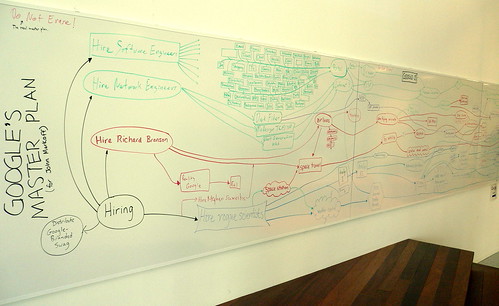
Google's Master Plan

Image
photo by Jurvetson (flickr)

The Invisible Web OR Skilled Curation and Search is Valuable

Google and other social search engines don't retrieve everything. Actually, according to this piece, they retrieve a small percentage. Worth a cruise through. Check it out: http://www.lagcc.cuny.edu/library/invisibleweb/characteristics.htm

Now, Google's Good for Granny

As I was surfing the web this a.m. I ran across a story about a recent study at the University of California, Los Angeles. The study set out to measure brain activity of older adults as they search the Web. The findings were interesting and operate as a nice antagonism to Nicholas Carr's "Is Google Making Us Stupid" published last summer in The Atlantic . The link to CNN's coverage of this study is here . The study was paid for by the Parvin Foundation and was published by Gary Small and Susan Bookheimer , both UCLA professors, and Teena Moody, a senior research associate at UCLA's Semel Institute. The paper was published in the American Journal of Geriatric Psychiatry . But I really was drawn to this piece, which I've only skimmed, because it seems to touch on how new practices of literacies do enable, sustain, and maybe even sharpen minds of all ages. Often the popular press argues for the legitimacy of digital natives' critical thinking skills tha...

Google's Big Plans and Possibilities in Africa

Today's New York Times featured an excellent article that illuminates some points made in my previous post last Friday. The piece, entitled " Inside Nairobi, the Next Palo Alto " details tactics for technology development and maximization at work in Kenya and other low-tech areas of Africa. The second portion of the article focuses on the influence of Google in Kenya, Google's increasing physical presence there, and the citizens' hopes for what Google can enable them to achieve. The article is linked above and pasted below. Hopefully, it adds to my supposition that perceived lackluster earnings reports from Google matter little when it comes to the company's influence on identity, ethos, and aspirations of global individuals and groups. http://www.nytimes.com/2008/07/20/business/worldbusiness/20ping.html?_r=1&ref=africa&oref=slogin

How to Look at Google the Wrong Way

Google reported 2nd quarter earnings yesterday afternoon , meeting analyst estimates, however warnings from company execs prompted a pretty significant drop in GOOG stock. Shares of GOOG fell over 10 percent in after hours trading Thursday and continued to hold the decline today. Google chairman Eric Schmidt's description of the economy as "challenging", coupled with admissions of slower hiring at Google and decreased consumer click-throughs of ads, are being cited as common analyst concerns. In a financial respect, some of the analyst concerns are warranted in the short term, but longer term they are not. It's also important to note that Google continues to lead our ever-emerging online experience even if they're not growing as rapidly as they were 6 months ago and if revenue looks different this quarter than it did last (when analysts were surprised at earnings and GOOG skyrocketed as a result). Importantly, there is no competition for Google in many of their c...